
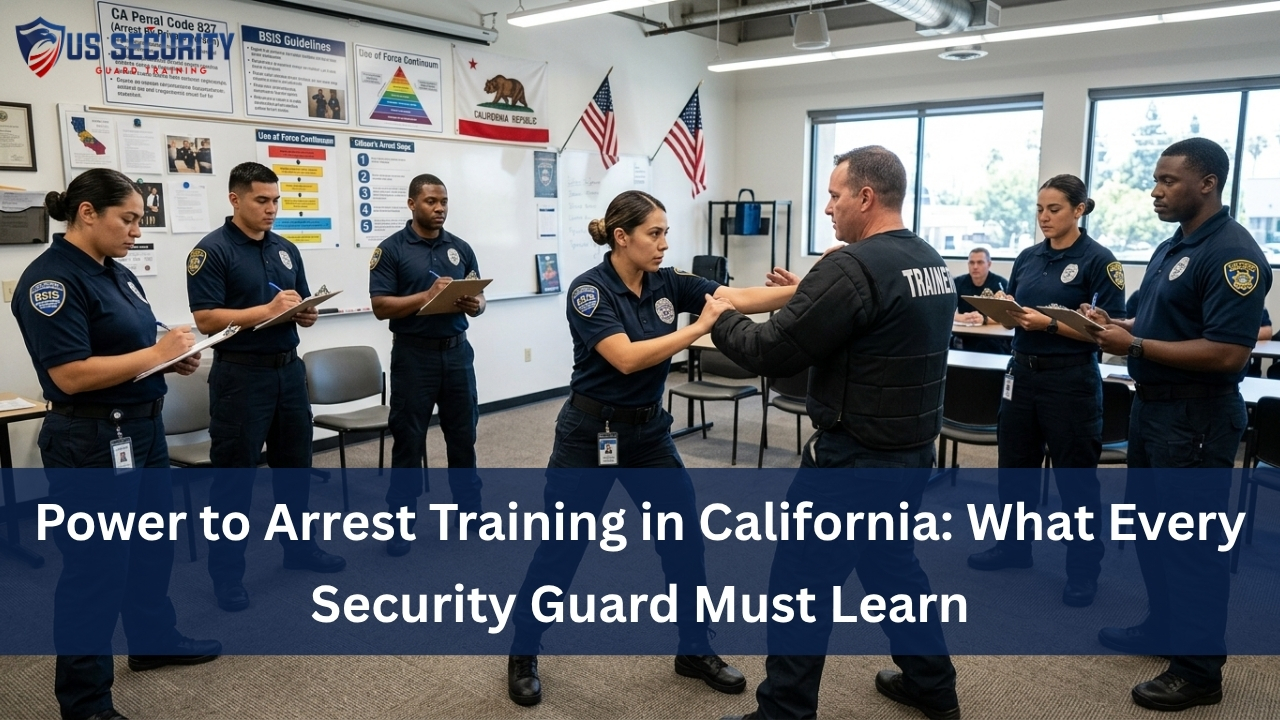
All security guards in California are required to take Power to Arrest training. This course will educate the guard on the legal boundaries they have to observe when detaining. This part may be a bit more challenging for new applicants. It’s, therefore, right at the beginning of your career. If you don’t have it, BSIS will not register your Guard Card. This guide will help you understand the material of the course and the importance of it. Plus, you’ll get information on the cost, time, and exam that will be required. By the end, you will know for sure the importance of this training.
What Is Power to Arrest Training?
Power to arrest training California is required before any guard is given the power. As such, BSIS came up with this course, after noticing that guards frequently misinterpret authority. It educates guards on the very narrow guidelines they need to follow in detentions. Therefore, this course is the basic course for guard licensing.
An applicant must not be legally registered as a guard until the process is completed. It can result in a significant legal issue down the road if it is not done correctly. If the guards do something wrong, then the employers are also liable for compensation. To sum up, all careers start with understanding these legal limits!
Who Must Complete This Training
This is a course students must complete prior to applying for a California Guard Card. Further, this comprises guards, officers on patrol as well as private security personnel that are not armed. All guards, regardless of experience level, from other states, must attend the California specific course.
In fact, the certificates from other state agencies are not accepted by BSIS. Experience in the military or law enforcement does not excuse applicants either. That State agencies have their own individual, non-transferable training standards. That is, all of us begin the game at the same starting point—legally speaking. This is true for both armed guards and unarmed personnel and supervisors.
Why California Requires This Course
The security guards have lesser legal powers than the common man. Therefore, BSIS needs to be educated about that authority before giving it to anyone. This is for the good of the public, the guard, and the hiring employer. In the meantime, inexperienced guards put themselves at a huge risk of incurring legal liability in unclear situations. Development of this training was a real public safety measure made by Lawmakers. The bottom line: harm prevention.
What Power to Arrest Training Covers
This course is very narrowly focused on the legal aspects of the guard of authority. Students are taught, for instance, where their power starts and stops. Guards can practice law in real-life situations. This means that when a graduate leaves, he/she has not only a grasp on theory but also an understanding of practice.
Legal Authority of Security Guards
Security guards remain non-officer of the law and their powers remain confined. In addition, this section defines the legal actions and actions that are not allowed for guards. Students are taught about the intersection of private property rights and public safety. In general, these boundaries are made memorable for the instructors through real-life situations.
Detention vs Arrest
The biggest problem is that guards get the idea of “temporary detention” mixed up with a formal citizen’s arrest. This module therefore helps to explain the distinction between these two actions. The difference between them is very clear, so that guards will not exceed their limited powers. A slight error here can lead to huge legal liability. Specifically, guards appreciate learning from actual case studies while training.
Property Rights and Public Safety
There are certain rights that overlap guard authority which belong to the private property owner. In turn, teachers will explain how the laws around trespass apply to everyday tasks. This balance is to protect the property owner and any person who visits the property. Guards therefore apply these principles to a variety of work environments, sometimes quite different, that are unpredictable.
Citizen’s Arrest Rules in California
Citizen’s arrest is only permitted by California law under certain and limited circumstances. Otherwise, this can leave guards open to liability or lawsuits. Before guards can do anything but what is prescribed by these rules, they need to be familiar with them. Specifically, this section goes through the exact legal standard that guards are required to satisfy.
When an Arrest Is Lawful
Only under certain conditions is an arrest legal. For example, an unlawful arrest can cause trouble with the law. Guards become adept at identifying these conditions in a relatively short time in actual scenarios. Of course, violating these conditions can leave a guard liable.
Documentation After an Incident
After any detention or arrest, proper documentation will safeguard the guards. Thoughtful records also serve to safeguard employers if there is a legal or insurance controversy later. Teachers train guards on the information they must include in an incident report. Reports should cover the time, witness and a factual summary. Likewise, guards learn to write clear and factual reports through hands-on exercises.
New 2026 Rules Under SB 652
Senate Bill 652 made important changes to training laws in California. So it is important to be aware of these changes before applying so there will be no wasteful mistakes being made. These adjustments will impact the way that applicants undertake their training as a Power to Arrest.These changes affect the way applicants will undertake their Power to Arrest training. The overall impact is to create a more uniform application process for all applicants. The changes have been made by lawmakers based on a review of previous standards.
The Single-Provider Requirement
As of 1 January 2026, one licensed provider will have to do everything. This rule helped to close a confusion for many applicants. Power to Arrest and Use of Force training cannot be divided. Indeed, providers who send students to other providers are not currently BSIS compliant.
The In-Person Training Component
The required course structure now requires a hands-on component in the course for BSIS. Rather, only online courses are no longer enough to fulfill the training mandate. This change allows guards to experience the whole situation, rather than watching videos passively. Furthermore, interactive training enables guards to be better prepared for what they can expect in combat.
How to Complete Power to Arrest Training
If done right, this training will save both your time and money. As a result, take the following steps carefully so that there is no delay in the process or rejection.
Selecting a BSIS Approved Provider
Before signing up, ensure that your provider is currently approved by BSIS. Also, inquire if they offer both modules as part of one certification. A good provider will state this openly and will give evidence when requested. Otherwise you may end up joining a non-compliant and unreliable training company.
Passing the Required Exam
All applicants attend training and then complete a Power to Arrest and Use of Force exam. BSIS only currently takes 100 percent marks. Interestingly, a single wrong answer means that the entire test will need to be retaken. Review your class material carefully as re-takes will postpone the applications. In addition, you will see that most providers have practice questions to help the students prepare with confidence.
Cost and Timeline of the Training
Costs of courses vary according to the provider, location and materials provided. The typical pre-application programs cost anywhere from about $50 to $150. Expect to take one full day as sessions are likely to be back to back. Then you will still have to pay the individual BSIS application fee. Major cards, as well as typical digital payment choices are accepted by most providers. Some providers include study guides, practice questions, or printed workbooks. But beware, if it is cheaper, sometimes it doesn’t include materials.
What Happens After You Finish
When this training is completed, the next step in your application. Next, there are two more steps to getting your official Guard Card from BSIS.
Applying Through BreEZe
The majority of applicants will submit paperwork via the California BreEZe online system. If not, this is where common errors frequently occur resulting in unnecessary delays during BSIS processing. Fill in details of the training as specified on the certificate. Also, double check all the fields before submitting your application once it’s complete.
Live Scan and Next Steps
Live Scan fingerprinting is also required when registering. Moreover, BSIS carries out this background check to validate the eligibility of applicants across the State. Some beliefs can result in a delay or rejection of an application in this review. When you receive your Guard Card, it arrives in several weeks, overall.
Power to Arrest vs Appropriate Use of Force
Only legal authority is the focus of Power to Arrest training California. Appropriate Use of Force training emphasizes the physical response decision-making process. Both of these modules together equate to the same pre-application course. But in actual fights neither module can replace the other. In the event of an actual incident, guards must have both of these viewpoints.
Why US Training Guard Recommends Proper Preparation
At US Training Guard, we know that informed applicants experience no costly delays. Moreover, knowing all the legal restrictions in advance can smooth the way for your career. All future guards are encouraged to read these rules carefully. Finally, going the extra mile today really helps your career and your employer.
FAQs
What is “Power to Arrest” training in California?
It covers the law on the actions of a security guard in detaining a person.
Do guards need to be trained in Power to Arrest?
Yes, BSIS will not issue a Guard Card until proof of completion is provided.
Is it possible to take Power to Arrest training online?
No, this is not allowed under the current rules; instruction must be in person as well.
What is the cost of the Power to Arrest training?
Overall, the cost is typically fifty to one hundred fifty dollars.
Will I have to take an exam after?
Yes, applicants will need to obtain a 100% on the necessary BSIS exam.
What happens if I skip this training entirely?
Your Guard Card application will be rejected or returned by BSIS.
Conclusion
Power to Arrest training California is a must-have prior to any licensing. Thus, sticking with an adherent, single service provider guarantees your timeline and your investment. It covers legal authority, limits of detention, and good documentation procedures.
In particular, new 2026 rules will increase provider choice. Instead, your careful preparation pays off all along your career. Here at US Training Guard, we assist the users of our system to grasp these requirements as clearly as possible. In conclusion, doing this training properly ensures long-term success in the career.