
Security guards can legally carry batons and pepper spray that are certified. Both permits are regulated in California by the Bureau of Security and Investigative Services. The guards are not allowed to have a baton or chemical spray without state authorization.
This guide tells you what California needs before you can carry either of the tools. We include the base guard card, hours of training and the application process. We also describe the differences between baton training and pepper spray certification regulations.
You will know all the steps required in order to be certified appropriately by the end. Regulations are subject to change and it is always best to ensure that the information is current with BSIS itself. This is important to read through each part, as future steps are based on previous requirements mentioned here.
What Is Baton and Pepper Spray Certification
Baton pepper spray certification California merely implies individual permits on top of a guard card. Both permits demonstrate that you have been having state-approved training on that particular tool. In the absence of these permits, it is technically illegal to carry either of the items on duty throughout the state.
Under the baton permit, the expandable, straight, and side-handled batons have a single license. Pepper spray certification includes chemical sprays such as tear gas and OC spray. The two permits need practical training by a BSIS-certified training center within the vicinity.
How the Certification Process Works
Applicants must either have or be seeking a valid guard registration. This BSIS reviewed registration is known as a guard card. Upon registration, guards have the option of obtaining other permits on specialized equipment such as batons.
Each time a course is completed, training providers send completion records to BSIS. Application is then checked by the Bureau after which an official permit or an identification card is issued. Processing times are not uniform and thus use of early prevents overall unnecessary employment delays.
Why You Need a Guard Card First
California law mandates all security guards to have an active registration card. This card is used to confirm that you have passed a background check in state and federal databases. Without a valid registration number, employers will not have guards on duty.
The guard card procedure involves attending the Power to Arrest training prior to that. This is a basic course that deals with the authority of the law, morals, and the use of force in a proper way. Candidates may only receive training in baton or pepper spray after they have completed this step.
Baton Permit Requirements in California
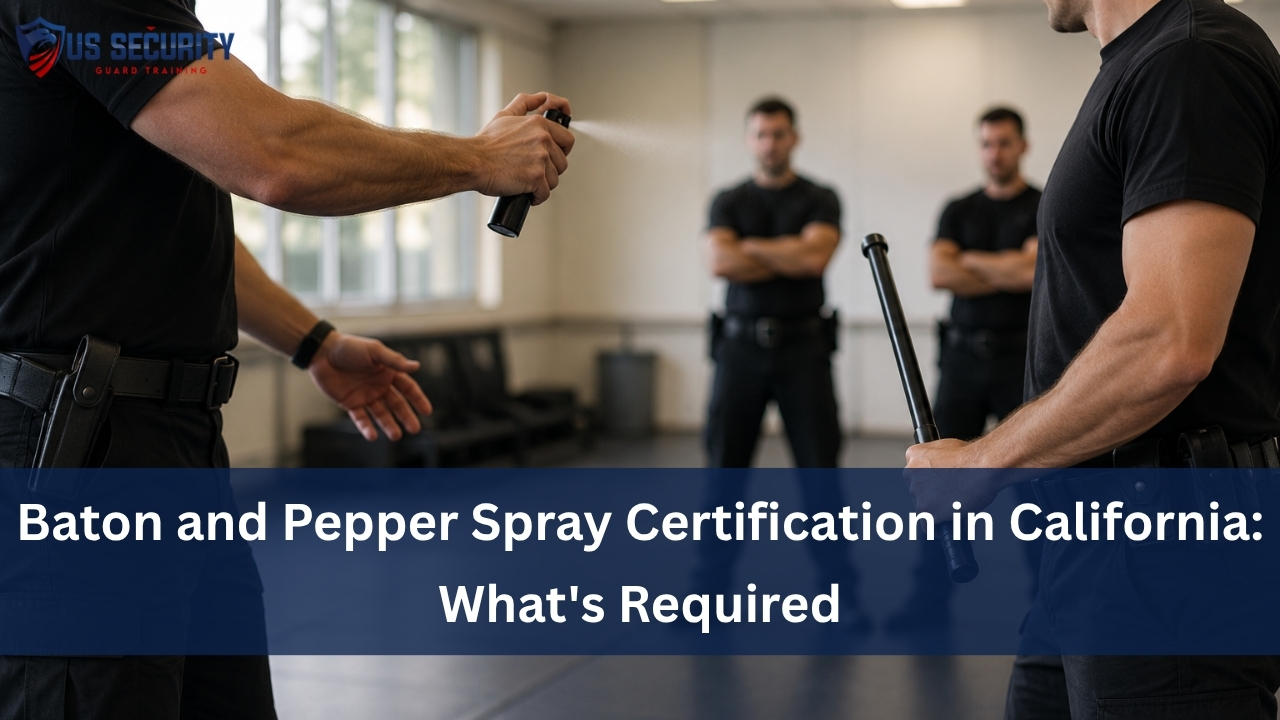
In California, no guard can carry a baton without a separate baton permit. Baton training should occur within a physical classroom as opposed to some other permits. The state requirements include practical sessions with a qualified teacher.
Students are taught how to hold the baton, how to strike, and what the law says about using the baton. Scenarios in which the use of the baton will be regarded as excessive force are also discussed by instructors. This pragmatic format makes the guards aware of technique and legal limits.
What the Baton Training Course Covers
Defensive postures, blocking practice and controlled striking practice are usually covered in courses. Case law on cases of improper or excessive use of the baton by students is also examined by the students. Also, the teachers will elaborate on when it is legally right to carry a baton during duty.
The majority of baton courses take a few hours, with physical exercises and lectures. After completion, students are given documentation which BSIS will use to issue the permit. Baton permits (as opposed to guard cards) usually have no expiration period.
Pepper Spray Certification Requirements
Chemical agents training is alternatively known as pepper spray certification, which has a different approval pathway. To carry OC spray legally, guards are required to have a state approved course. This training clarifies on how to store, use and legal restrictions of using the chemical agents. The baton and pepper spray certification are completed jointly, which prepares guards for most of the duties.
How Chemical Agents Training Differs from Baton Training
In contrast to baton training, pepper spray certification occasionally permits part-time online learning as well. This is because the chemical agents are more flexible, hence easier and less expensive to get. Nonetheless, the two permits are subject to an active guard card prior to the approval of BSIS.
The chemical agents card will be valid as long as your guard card is active. This particular permit is also renewed when your base registration is renewed on time. Review existing BSIS directions regularly, as renewal regulations are sometimes revised throughout the state.
How to Apply for Your Permits Through BSIS
The majority of applications are now processed via BreEZe, the official online licensing site of the Bureau. The applicants will open an account, post the necessary documents and pay the processing fees. Online submission is usually weeks faster than the time of sending paper applications.
Training completion certificate must be obtained before application, with your approved instructor or facility. You will also be required to have your current guard card number that will be checked. Check each form field twice, as mistakes are the major reason why the Bureau takes time to process.
Common Application Mistakes to Avoid
It is common to see many applicants forgetting to attach their signed training completion certificate in the right way. Meanwhile, there are other people who apply and do not even have their guard card status activated. Lack of signatures or missing parts are also common contributors to unnecessary processing delays statewide.
Never submit any permit application online without first having looked at the published checklist of the Bureau. Initial investments of additional time tend to save weeks of aggravating back and forth communication. This has led to thorough planning, which saves on time and money that would be spent on reviewing errors made later.
Costs and Renewal Timelines
Training in batons can range at an average of one hundred dollars, depending on the trainer. The permit itself has application fees of around half the cost. Pepper spray training is usually cheaper as the courses are much shorter.
Since the baton permit in itself never expires, its status is next to guard card status. Chemical agents certification is also typically two-year renewable. Combining the budgeting of both courses can save real-time and money to the candidates.
What Happens If You Carry Without a Permit
It is legally significant to have a baton or pepper spray without appropriate certification. Guards face the threat of being disciplined, fined or even have their guard card suspended. Another liability to the employers is the case where uncertified guards report to duty with restricted equipment.
In addition to legal risk, the uncertified use endangers the possibility of improper management of these tools. Correct training will decrease the risk of injury on both the guards and the people they are safeguarding. Being certified thus is a way of safeguarding your career as well as those around you on a daily basis.
Selecting the appropriate Training Provider.
Begin by ensuring that the provider is actively certified in BSIS to teach batons. Inquire about pepper spray training in person, online, or hybrid training. Consider the reviews of former students to understand the quality of the instructors and professionalism.
Research prices of various providers and only get committed to a particular training package. Nevertheless, the cheapest price does not necessarily imply high-quality instructions. Ensure that the provider sends completions directly to BSIS to prevent unwarranted delays.
Setting Reminders for Renewal Deadlines
Failure to renew on time can automatically put your certifications on hiatus without any prior notice. Mark calendar events a few weeks before your card expiration date comes. Early renewal ensures that there is no lapse between your present permits and subsequent cycle.
What Employers Look for in Certified Guards
When hiring, employers usually favor candidates with baton and pepper spray permits. With both certifications, it is possible to accelerate the hiring and onboarding. Certain jobs are such that armed-adjacent training must be satisfied, prior to scheduling guards to work on more hazardous shifts.
Refresher Training and Staying Sharp on the Job
Although the baton permit itself does not officially expire, the lack of practice leads to loss of skills. BSIS promotes continuous education to guards in order to remain competent and confident. Lots of training facilities provide additional practice in the form of optional refresher courses to guards.
FAQs
Where in the state of California can I do my baton training online?
No, in California, baton certification must be taught in person. Depending on the provider, pepper spray training is sometimes partial online training.
Before I take either of these certifications, am I required to have a guard card?
Yes, there are requirements that the applicants have to possess an active guard card or have applied to obtain one. Neither permit can be issued without a valid underlying security guard registration.
How many years does a California baton permit last with guards?
The baton permit alone does not have an independent fixed expiration date at the moment. Nevertheless, it is directly related to the active registration of your guard card.
What happens in case my guard card runs out of time before it is renewed?
Your baton and pepper spray authorizations go dead with your guard card that runs out. You can (and should) automatically renew your base registration, and this will fully renew your specialized carrying permits.
Do all single security guards state-wide have to be pepper spray certified?
No, this particular certification is only required to guards that intend to use chemical agents. Several jobs of unarmed guards do not involve any pepper spray training whatsoever.
Conclusion
Baton pepper spray certification California empowers California guards, who have the legal right to carry tools. A successful training will guard your career and will ensure that the people are truly safe. Before taking a particular training course, always ensure that the BSIS requirements are up to date.
In the US Training Guard, we develop courses that are at the state licensing standards. Our teachers pay emphasis on the practical and practical skills needed in the real-world situations. Since regulations are periodically changed, our curriculum is also up to date with the latest BSIS guidelines. Take action and commit to the next level by registering in a reputable training program.