
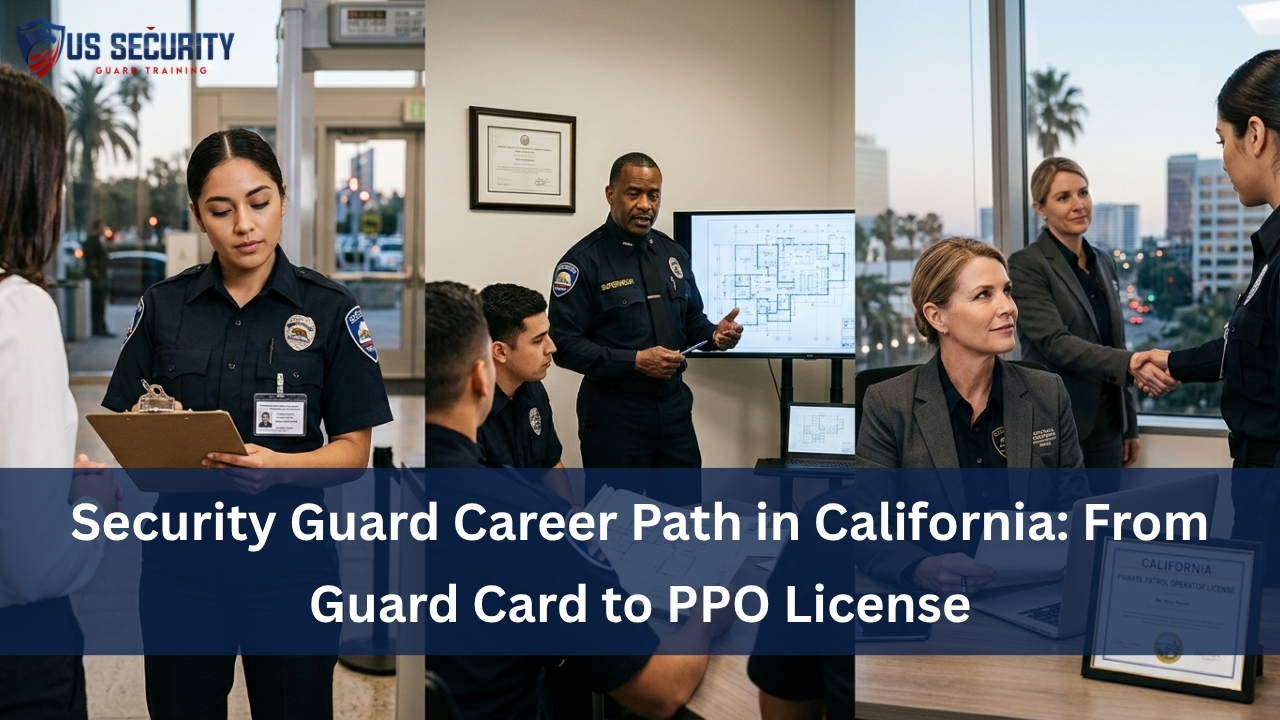
Many have greatly underestimated the extent to which a career as a California security guard can take them. What begins as a low-level job has the potential to become a career, a specialized and high-paying one at the same time. And to those with the ambition of going even further, it can even result in being the owner of a licensed security company.
The honest licensing procedures, established promotion routes and uniformity of industry demands turn this into a career worth considering. We shall step through each step of the California security career path, starting with your very-first guard card application and on up to a Private Patrol Operator license. We will discuss what each step involves, its average duration, and what it opens to your career.
Why a California Security Guard Career Is Worth Pursuing in 2026
Growing Industry Demand Across California
The security professionals in California have been in increasing demand and do not seem to be decreasing. Companies, hospitals, construction premises, shopping malls and residential areas require skilled and trustworthy security guards. In Los Angeles alone, the amount of active security contracts is ever-growing in tandem with the commercial development and population growth.
Salary Growth Potential at Each Career Stage
The minimum wage security jobs are better paid than most individuals would imagine. The wages increase significantly with experience and qualifications. The initial pay an unarmed guard receives can be a competitive hourly wage which in most cases is higher than the general entry level pay. Supervisors, site managers, and highly-skilled individuals like executive protection officers charge even higher rates.
Stage 1 – Getting Your California Guard Card
What a Guard Card Is and Who Requires It
Guard card is the basic license that one needs to operate as a security guard anywhere in California. All security guards working within the state should possess a valid guard card issued by the Bureau of Security and Investigations Services, also referred to as BSIS. In the absence of this card, it is illegal to work as a security guard irrespective of experience or employer. All careers of California security guards begin there.
BSIS Requirements for a Guard Card
Applicants should be 18 years and legally permitted to work in the United States to obtain a guard card. The application process includes a criminal background check, and some convictions can disqualify an applicant. Before obtaining their temporary guard card, the applicants are required to undergo eight hours of security training. Further training (32 hours) should be done within six months of the work commencement as a guard.
Stage 2 – Working as an Unarmed Security Guard
Entry-Level Roles and Responsibilities
The majority of California security guard careers start with the unarmed work in various settings and industries. The typical entry-level jobs are in the retail shops, office buildings, parking facilities, hospitals, and residential areas. The duties of guards at this stage include patrol, surveillance and reporting of suspicious activity, and the response to the incidents they are in charge of.
Building Experience Across Different Environments
A guard that has experience in retail loss prevention, hospital security and construction site patrol builds a much more extensive skill set than the guard that remains in the same environment. Every setting provides a different lesson about security work, such as de-escalation in medical facilities or access control in business buildings. Bosses and managers can see that a guard wants to have diverse experience and treat every task as something he or she does with interest.
What Skills to Develop Early in Your Career
It is during the early career stage when one should take an active effort to acquire skills that will be important in a long career. Effective written and oral communication is critical since a security worker will have to report frequently, write up papers and deal with people. The skills in customer service are more important than many novice guards think, as on a daily basis, the job may require contact with employees, visitors, and the general public.
Stage 3 – Getting Your Firearm Permit and Becoming an Armed Guard
Requirements for a California Firearms Qualification Card
To change the status of unarmed to armed, one needs to acquire a Firearms Qualification Card that is also issued by BSIS. Prior to firearm authorization, applicants must already possess a valid guard card. It consists of several steps such as taking an approved course in firearms training offered by BSIS on legal use of force, safety of firearms and qualification as a range. The armed guard licensing process in California also requires a psychological assessment as part of the process.
Training Hours and Qualification Process
The first firearms training course to obtain a Firearms Qualification Card includes a specified number of range hours and classroom training. Guards are required to show skills in handling the type of firearm they are supposed to carry when they are on duty. Other guards undergo training in various types of firearms to expand the amount of assignments they can undertake.
Stage 4 – Advancing to Supervisor and Management Roles
What Security Supervisors Do
Security supervisors are in charge of groups of guards at a single site or multiple sites, and have wider areas of operation. They also control the scheduling, performance reviews, interact with clients, and address escalated incidents. Supervisors in most cases are the main source of contact between the security company and the client businesses that the security company caters to. This position demands more than just security knowledge and also people management, administrative ability and professional judgment.
Skills and Experience That Lead to Promotion
The consistent pattern of reliability, initiative and professional behavior is common in guards who are promoted to the positions of supervisors. Managing challenging situations without losing your temper and this is indicative of supervisory potential. The most sure way of progress is to create such a track record on purpose and regular.
Stage 5 – Specialized Certifications That Open Doors
Executive Protection Certification
The certification programs in this area include advanced work, threat assessment, protection driving, and close-quarter protection methods. Such programs are generally higher end and pricier than usual security training but demand a high pay and an opportunity. Being the center of celebrities, executives and high-net-worth people, Los Angeles has a regular need of trained executive protection professionals.
Alarm Agent License
This license has a separate application, background check and training process on top of the guard card. The residential and commercial alarm response, monitoring systems, and technical security installations are also common in alarm agent work. The inclusion of this qualification in a security career increases the range of employers and jobs available.
Baton and Chemical Agent Permits
California security guards who would like to carry a baton or the chemical agents like pepper spray must be issued with individual permits to the same. In some workplaces, employers demand or highly favor those guards with these supplementary permits. Including them at the beginning of a career has a more extensive range of assignments with minimal extra investment.
Stage 6 – Obtaining Your PPO License and Starting a Company
What a Private Patrol Operator License Is
The top level license offered by BSIS is a Private Patrol Operator license, which is necessary to own and operate a security company in California. The PPO license is the final stage of the California security guard career of those who would like to become entrepreneurs. It lets the door open to creating a team, acquiring contracts, and working at the business level as opposed to the level of individual guard.
California PPO License Requirements in 2026
The applicants should possess two years of experience in the field of private security as a manager or supervisor. The applicants should also successfully pass a written examination on California security laws, business operations and ethics. A surety bond and proper liability insurance must be provided and submitted in the form of an application.
FAQs
What is a PPO license in California?
A Private Patrol Operator license is the state-authorized license to own. It operates a security company in California, issued by BSIS upon completion of experience and examination, and financial criteria.
What is the salary of security guards in California?
The pay differs depending on position and qualifications as unarmed guards are paid competitive hourly wages. Armed guards have higher wages, and supervisors and specialty professionals receive higher pay.
What are the certifications that enable security guards to progress?
The certification of executive protection, the license of alarm agents, and the permits of baton and chemical agents make the range of assignments possible. It increases the professional profile of a guard to move up the rank ladder.
Conclusion
A career in California security guards is something truly unheard of in the job market these days; a definite, well-laid roadmap of an easily reachable starting point to the very top, that of owning a business. The security industry in California values those professionals who embrace their credentials, skills and behaviors at all levels. US Training Guard boasts of serving the security professionals at all levels. When you are willing to go the extra mile, the next way to go is not as foggy as you may believe.